Synthesising Biological Reality and Lived Experience in Indian Constitutional Law
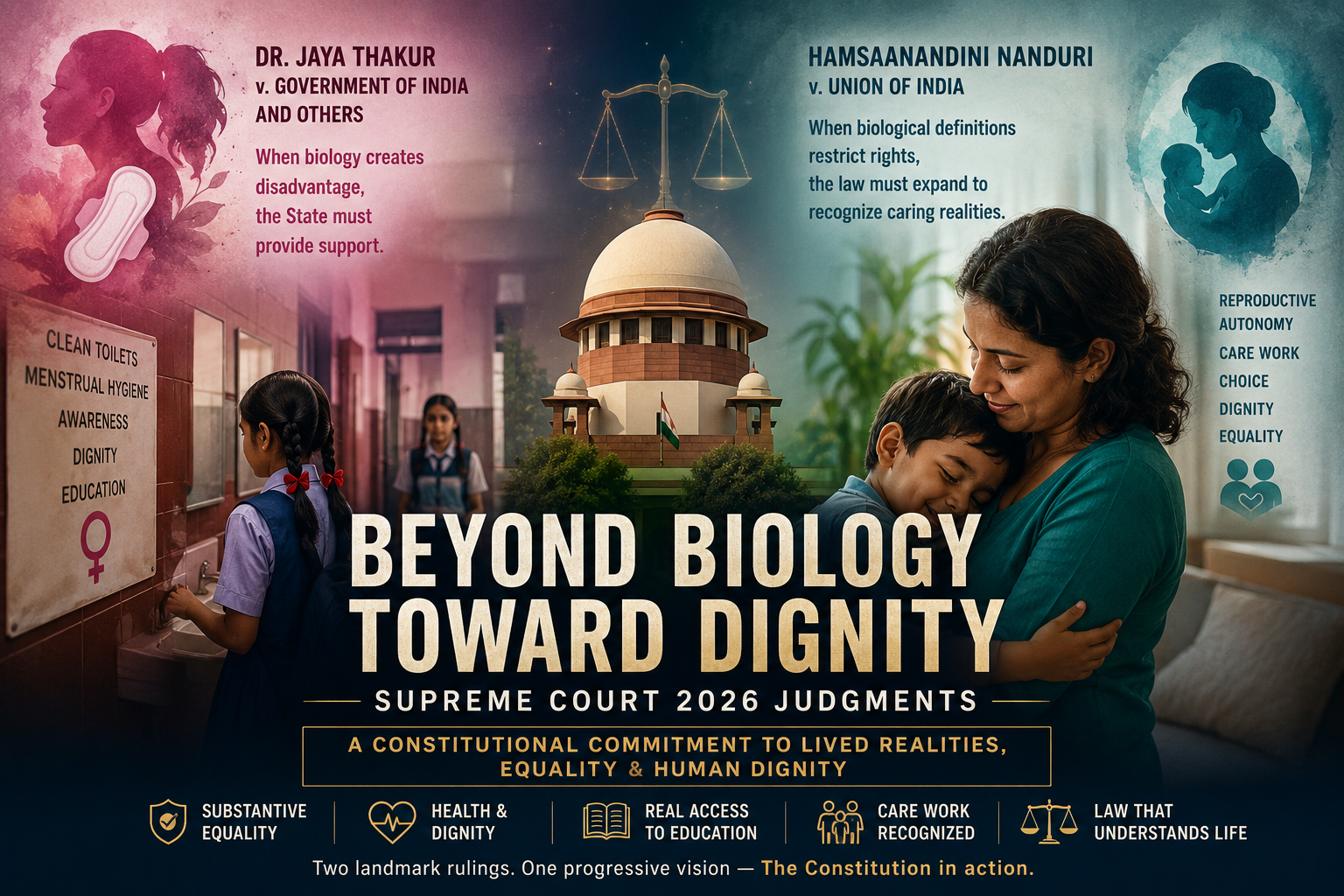
In a pair of landmark 2026 decisions—Dr. Jaya Thakur v. Government of India and others decidedon January 30, 2026and Hamsaanandini Nanduri v. Union of India decided on 17 March, 2026—the Supreme Court of India fundamentally reframed the constitutional dialoguesurroundinggender,bodilyautonomy,andcaregiving.Viewedindividually,onecase anchors itself in biological reality while the other moves beyond it. Read together, however, theyrevealacoherentjurisprudence:theIndianConstitutionisevolvingfromaformalmodel ofidenticaltreatmenttoasubstantiveframeworkfocusedonlivedexperience,humandignity, and structural equality.
Dr.JayaThakur:BiologyasaStructuralBarrier
In Dr. Jaya Thakur, the Court addressed a Public Interest Litigation (PIL) highlighting how the lack of menstrual hygiene products, clean toilets, and awareness drives school absenteeism and high dropout rates among young girls.
Reframing a perceived administrative issue into a fundamental rights mandate, the Court linked menstrual health directly to Articles 14, 21, and 21A:
• Substantive Equality (Article 14): Identical facilities for boys and girls ignore distinct biological realities, perpetuating unequal outcomes. Equality requires accommodations that remove systemic hurdles.
• Dignity and Health (Article 21): Forcing girls to manage menstruation without basic infrastructure violates bodily privacy, reproductive health, and personal dignity.
• Real Access to Education (Article 21A): Formal school enrollment is meaningless if unaddressed biological processes force students out of classrooms.
The Courtheldthatmenstruationbecomes aconstitutionalconcernnot merely because itis abiologicalfunction,butbecauseunmitigatedbiologicalburdenscreatestructuralinequality.
HamsaanandiniNanduri:CaregivingBeyondChildbirth
Conversely, Hamsaanandini Nanduri questioned whether biological childbirth is the sole metric for maternal protections. The petitioner challenged a statutory provision granting maternityleaveonlytomothersadoptinginfantsunderthreemonthsofage—aconditionthat excluded most adoptive parents due to lengthy legal procedures.
Striking down the restriction, the Court re-centered maternity protection on care work and personal choice:
• Arbitrary Classification (Article 14): Presuming that older adopted children do not require intensive bonding creates an irrational, self-defeating distinction.
• Reproductive Autonomy (Article 21): Choosing to adopt falls under personal liberty. Denying leave penalizes non-biological parenting choices and disrupts the child’s adjustment.
• Valorizing Care Work: Motherhood is defined by nurturing, responsibility, and emotional bonding—not just physical recovery from childbirth.
Synthesis:AConstitutionalMovementTowardLivedRealities
Theserulingsarecomplementarysidesofthesameconstitutionalcoin:
• When biological realities create disadvantage, the State must step in to provide structural support (Jaya Thakur).
• When biological definitions restrict rights, the law must expand to recognize social, legal, and emotional realities (Hamsaanandini Nanduri).
By looking beyond the physical body to protect how individuals actually live, the Supreme Court has anchored substantive equality in the everyday realities of health, education, and family life.
Dr.JayaThakur:BiologyasaStructuralBarrier
In Dr. Jaya Thakur, the Court addressed a Public Interest Litigation (PIL) highlighting how the lack of menstrual hygiene products, clean toilets, and awareness drives school absenteeism and high dropout rates among young girls.
Reframing a perceived administrative issue into a fundamental rights mandate, the Court linked menstrual health directly to Articles 14, 21, and 21A:
• Substantive Equality (Article 14): Identical facilities for boys and girls ignore distinct biological realities, perpetuating unequal outcomes. Equality requires accommodations that remove systemic hurdles.
• Dignity and Health (Article 21): Forcing girls to manage menstruation without basic infrastructure violates bodily privacy, reproductive health, and personal dignity.
• Real Access to Education (Article 21A): Formal school enrollment is meaningless if unaddressed biological processes force students out of classrooms.
The Courtheldthatmenstruationbecomes aconstitutionalconcernnot merely because itis abiologicalfunction,butbecauseunmitigatedbiologicalburdenscreatestructuralinequality.
HamsaanandiniNanduri:CaregivingBeyondChildbirth
Conversely, Hamsaanandini Nanduri questioned whether biological childbirth is the sole metric for maternal protections. The petitioner challenged a statutory provision granting maternityleaveonlytomothersadoptinginfantsunderthreemonthsofage—aconditionthat excluded most adoptive parents due to lengthy legal procedures.
Striking down the restriction, the Court re-centered maternity protection on care work and personal choice:
• Arbitrary Classification (Article 14): Presuming that older adopted children do not require intensive bonding creates an irrational, self-defeating distinction.
• Reproductive Autonomy (Article 21): Choosing to adopt falls under personal liberty. Denying leave penalizes non-biological parenting choices and disrupts the child’s adjustment.
• Valorizing Care Work: Motherhood is defined by nurturing, responsibility, and emotional bonding—not just physical recovery from childbirth.
Synthesis:AConstitutionalMovementTowardLivedRealities
Theserulingsarecomplementarysidesofthesameconstitutionalcoin:
• When biological realities create disadvantage, the State must step in to provide structural support (Jaya Thakur).
• When biological definitions restrict rights, the law must expand to recognize social, legal, and emotional realities (Hamsaanandini Nanduri).
By looking beyond the physical body to protect how individuals actually live, the Supreme Court has anchored substantive equality in the everyday realities of health, education, and family life.

