Delimitation in India: The Power Struggle
1. The Core Concept
Delimitation is the constitutional process of redrawing constituency boundaries after a Census to ensure equal representation. This structural balancing mechanism enforces the fundamental democratic equation:
{ 1 Person } = { 1 Vote } = { 1 Equal Value }
Governed by Articles 82 (Lok Sabha) and 170 (State Assemblies), it is executed by an independent Delimitation Commission led by a retired Supreme Court judge. To safeguard the process from immediate partisan maneuvering or lengthy judicial interference, its decisions hold the force of law and cannot be legally challenged in any court.
2. The Historic Freeze
To prevent penalising states executing effective population control and family planning policies, a major legislative intervention was introduced. The 42nd Amendment (1976) froze seat allocation across states until 2001, which the 84th Amendment (2001) subsequently extended to 2026. Consequently, legislative representation has remained institutionalized at historic metrics and has not matched massive demographic shifts for decades.
3. The 2026 Gridlock
The upcoming expiration of the decades-long freeze has triggered an intense constitutional and political deadlock:
• The Legislative Push: The Government introduced the Delimitation Bill, 2026 alongside the Constitution (131st Amendment) Bill to expand the total seats in the Lok Sabha to roughly 850. This expansion was designed to enable the implementation of the historic 33% women's reservation mandate, which is structurally tied to the completion of the boundary adjustments.
• The Setback: In April 2026, the critical constitutional amendment failed to secure the required 2/3rd special majority in the Lok Sabha, completely stalling the operational framework and pushing the reform into a legislative impasse.
4. The North-South Conflict
The ultimate systemic controversy pits the foundational democratic principle of Equal Representation directly against the principles of Federal Fairness:
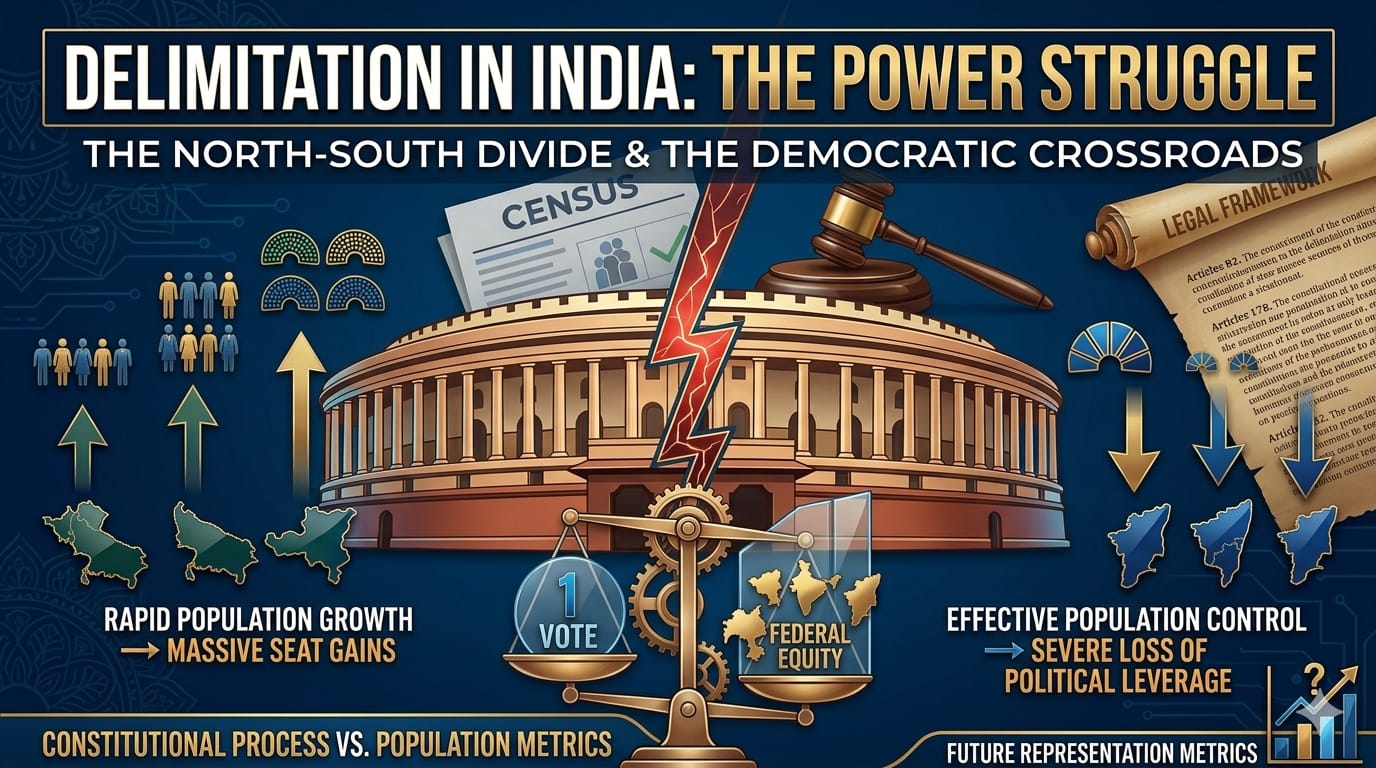
• The Northern Region: Rapid and unchecked population growth over the past several decades would yield massive seat gains, resulting in a dominant and asymmetric parliamentary influence over national governance.
• The Southern Region: Highly effective implementation of socio-economic development policies and population control measures would ironically result in a severe loss of relative political leverage and budgetary voice at the center.
While the federal government proposes increasing the total absolute number of seats across all states so that no region faces an outright drop in its number of representatives, the relative power balance will inevitably shift heavily toward the North due to sheer numbers.
India now stands at a critical democratic crossroads: it must choose whether to strictly follow raw population metrics to ensure standard voter equality, or actively protect federal equity for the states that successfully met national developmental and progressive goals.
Delimitation is the constitutional process of redrawing constituency boundaries after a Census to ensure equal representation. This structural balancing mechanism enforces the fundamental democratic equation:
{ 1 Person } = { 1 Vote } = { 1 Equal Value }
Governed by Articles 82 (Lok Sabha) and 170 (State Assemblies), it is executed by an independent Delimitation Commission led by a retired Supreme Court judge. To safeguard the process from immediate partisan maneuvering or lengthy judicial interference, its decisions hold the force of law and cannot be legally challenged in any court.
2. The Historic Freeze
To prevent penalising states executing effective population control and family planning policies, a major legislative intervention was introduced. The 42nd Amendment (1976) froze seat allocation across states until 2001, which the 84th Amendment (2001) subsequently extended to 2026. Consequently, legislative representation has remained institutionalized at historic metrics and has not matched massive demographic shifts for decades.
3. The 2026 Gridlock
The upcoming expiration of the decades-long freeze has triggered an intense constitutional and political deadlock:
• The Legislative Push: The Government introduced the Delimitation Bill, 2026 alongside the Constitution (131st Amendment) Bill to expand the total seats in the Lok Sabha to roughly 850. This expansion was designed to enable the implementation of the historic 33% women's reservation mandate, which is structurally tied to the completion of the boundary adjustments.
• The Setback: In April 2026, the critical constitutional amendment failed to secure the required 2/3rd special majority in the Lok Sabha, completely stalling the operational framework and pushing the reform into a legislative impasse.
4. The North-South Conflict
The ultimate systemic controversy pits the foundational democratic principle of Equal Representation directly against the principles of Federal Fairness:
• The Northern Region: Rapid and unchecked population growth over the past several decades would yield massive seat gains, resulting in a dominant and asymmetric parliamentary influence over national governance.
• The Southern Region: Highly effective implementation of socio-economic development policies and population control measures would ironically result in a severe loss of relative political leverage and budgetary voice at the center.
While the federal government proposes increasing the total absolute number of seats across all states so that no region faces an outright drop in its number of representatives, the relative power balance will inevitably shift heavily toward the North due to sheer numbers.
India now stands at a critical democratic crossroads: it must choose whether to strictly follow raw population metrics to ensure standard voter equality, or actively protect federal equity for the states that successfully met national developmental and progressive goals.

