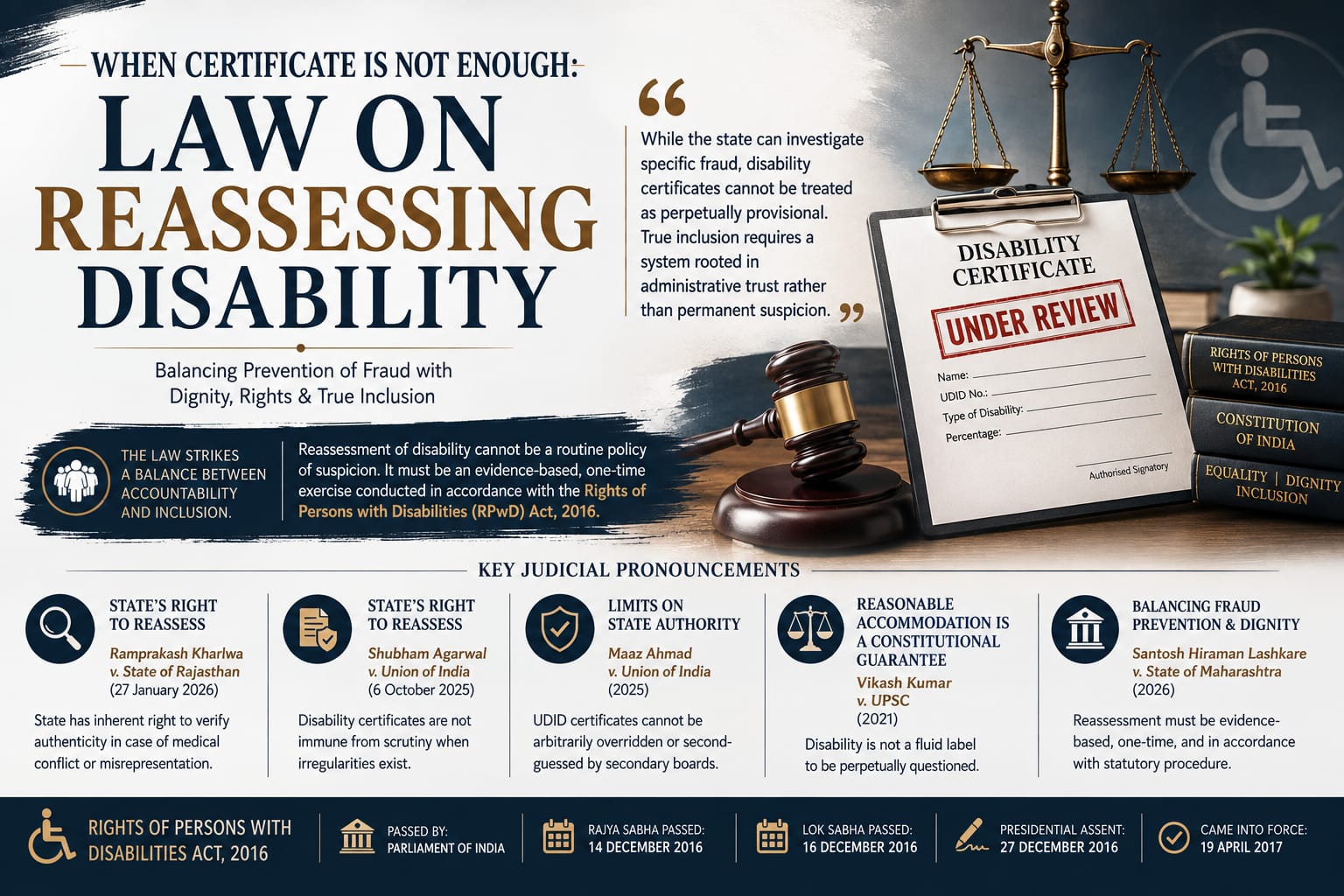
WHEN CERTIFICATE IS NOT ENOUGH: LAW ON REASSESSING DISABILITY
In recent legal developments surrounding disability governance in India, the article “When Certificate Is Not Enough: Law On Reassessing Disability” by Adan Fatima examines the legal tension between preventing fraud in public employment and safeguarding the dignity of persons with disabilities. The issue escalated after Maharashtra initiated a state-wide verification drive affecting over 700 government employees—including 21 schoolteachers in Pune—following suspicious patterns, such as a sharp rise in post-service hearing impairment claims under disability quotas. While many reassessments uncovered invalid or sub-threshold disability claims, the blanket scrutiny subjected genuinely disabled employees to degrading re-evaluations and sudden suspensions. Indian courts have attempted to reconcile these competing interests: State's Right to Reassess: In Ramprakash Kharlwa v. State of Rajasthan (decided January 27, 2026) and Shubham Agarwal v. Union of India, (decided October 6, 2025) courts recognized that disability certificates are not indefinitely immune from scrutiny. When genuine, documented medical conflicts or misrepresentations exist, the state holds an inherent right to verify authenticity. Limits on State Authority: In Maaz Ahmad v. Union of India (2025), the Allahabad High Court affirmed that authorized Unique Disability ID (UDID) certificates cannot be arbitrarily overridden or second-guessed by secondary medical boards. Furthermore, the Supreme Court’s landmark ruling in Vikash Kumar v. UPSC (2021) established reasonable accommodation as a core constitutional guarantee, cautioning against treating disability as a fluid label to be perpetually questioned. In Santosh Hiraman Lashkare v. State of Maharashtra (2026), the Bombay High Court struck a pragmatic balance. The Division Bench upheld the state’s authority to investigate potential fraud, but ruled that reassessment drives must be an evidence-based, one-time exercise rather than a routine policy of suspicion. The court quashed immediate suspensions and directed uniform examinations under statutory procedures outlined in the Rights of Persons with Disabilities (RPwD) Act, 2016. Ultimately, the law confirms that while the state can investigate specific fraud, disability certificates cannot be treated as perpetually provisional. True inclusion requires a system rooted in administrative trust rather than permanent suspicion.

